
IAI strengthens science diplomacy and regional cooperation to address climate challenges in Peru and the Andean region
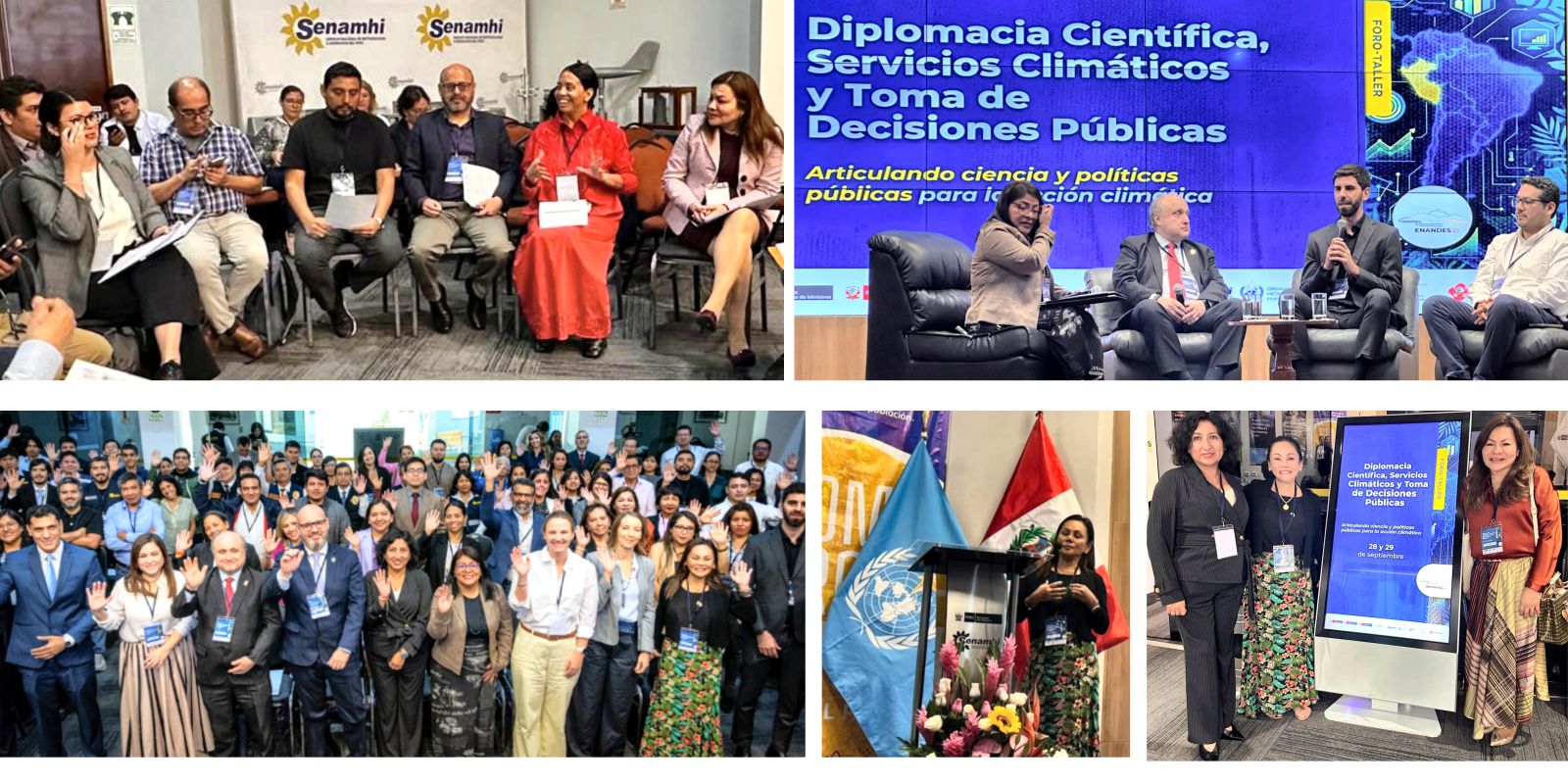
The IAI Science Diplomacy Center organized the Forum and Workshop “Science Diplomacy, Climate Services and Public Decision-Making” in Lima, bringing together more than 150 participants for the forum and nearly 50 professionals and specialists for the workshop to strengthen dialogue among science, public policy, and international cooperation.
The events were co-organized with Peru’s National Service of Meteorology and Hydrology (SENAMHI), the National Council for Science, Technology and Technological Innovation (CONCYTEC), Peru’s Ministry of Foreign Affairs, the Peruvian Amazon Research Institute (IIAP), the WMO Regional Training Center in Peru (RTC), in collaboration with the Embassy of Switzerland and the Regional Hub of Swiss Environmental and Humanitarian Cooperation, and the World Meteorological Organization (WMO).
The Forum and Workshop aimed to strengthen professional and institutional capacities in science diplomacy and enhance coordination among science, climate services, and public policymaking in Peru and the Andean region.
The activities brought together professionals and specialists, including public authorities, meteorological and hydrological services, science and technology institutions, universities, international organizations, and representatives of the diplomatic corps from different countries. The program addressed challenges such as the 2026–2027 El Niño, climate change adaptation, risk management, climate services, scientific advice, the Amazon, forest fires, and transboundary scientific cooperation. Participants included representatives from Peru, Argentina, Bolivia, Ecuador, the United States, Mexico, Panama, and Switzerland.
During the opening session, Grinia Avalos Roldán, Head of Peru’s National Service of Meteorology and Hydrology (SENAMHI), described science diplomacy as “a fundamental bridge to connect knowledge generation with public management” and to accelerate regional adaptation to climate change and extreme events.
Peru’s Vice Minister of Environmental Management, Raquel Soto, drew attention to a central challenge for climate services: going beyond the production of forecasts. “One of the major challenges is to move toward climate services that not only provide timely and clear the conditions to strengthen the interface between science and decision-making, reinforce the key role of scientific advice, and build regional responses to problems that no country can address in isolation.
One of the central themes was the relationship between science diplomacy and climate services. Important achievements and lessons learned from the ENANDES+ project were presented. Sessions on the 2026–2027 El Niño and Andean cooperation also examined how to transform forecasts and scientific knowledge into useful information for authorities and sectors responsible for anticipating risks, preparing responses, and strengthening adaptation. The program also included discussions on forest-fire monitoring and the resilience of Amazon ecosystems.
The meeting was designed to move from discussion to concrete proposals. During the second day, participants worked in groups on key elements for science diplomacy in Peru and the Andean region, climate services, Amazon cooperation, natural disasters and risk management, and the science-policy interface. The results discussed in plenary will serve as inputs for a policy brief containing science-to-action recommendations.