
Central American countries met in the Dominican Republic to strengthen science diplomacy and regional integration
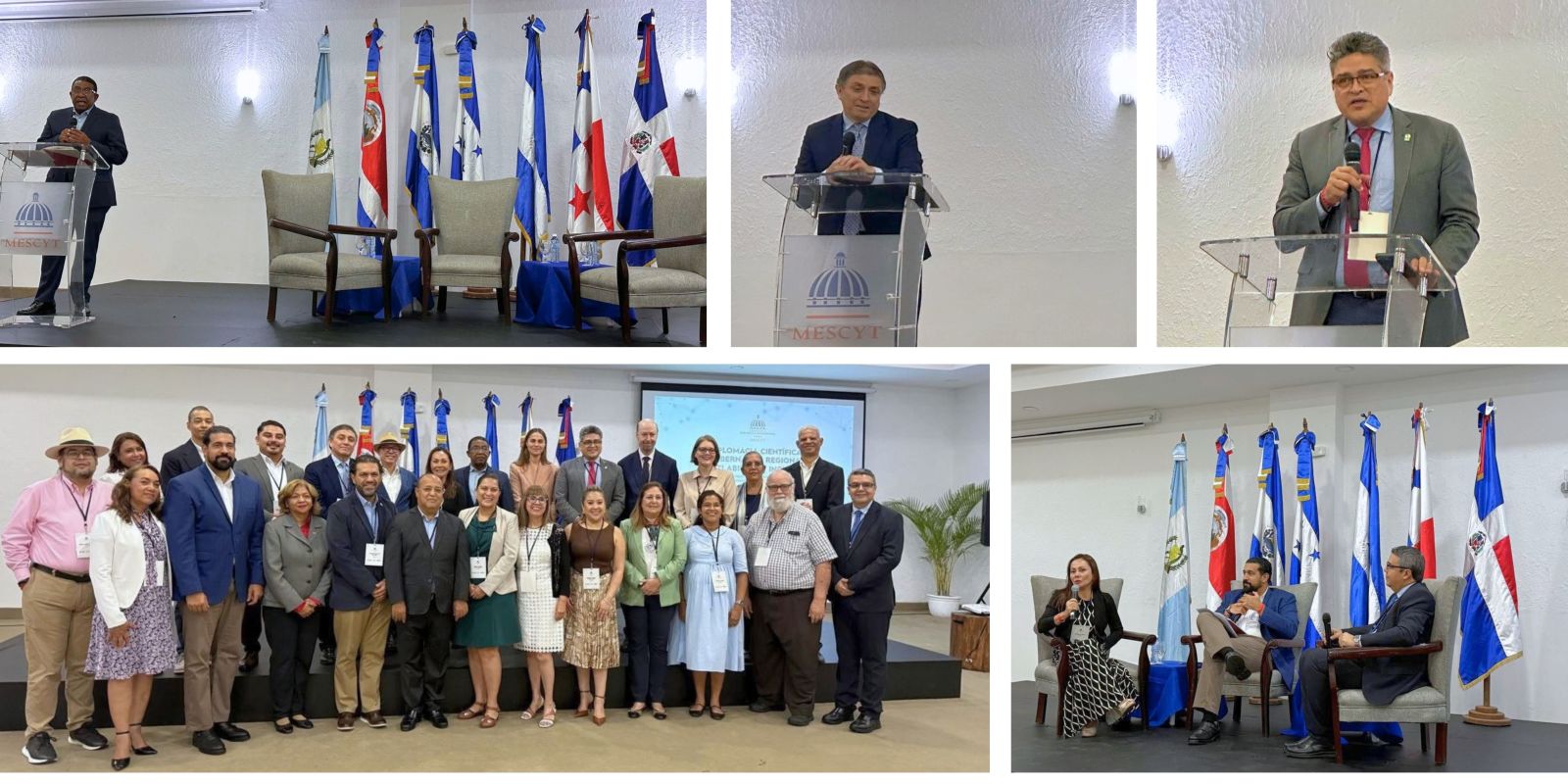
On 26 and 27 August, the Dominican Republic hosted the Regional Workshop “Science Diplomacy, Regional Governance, and Open and Inclusive Science, Technology, and Innovation: Toward the Implementation of the Regional Framework and the Strategic Strengthening of the CTCAP”, an official meeting aimed at promoting regional collaboration in science, technology, and innovation.
The event was organized by the Ministry of Higher Education, Science, and Technology of the Dominican Republic (MESCyT), within the framework of the Commission for Scientific and Technological Development of Central America, Panama, and the Dominican Republic (CTCAP), which is linked to the Central American Integration System (SICA).
The meeting brought together representatives from Costa Rica, El Salvador, Guatemala, Honduras, Panama, and the Dominican Republic, along with national authorities on science, technology, and innovation; officials from the Ministry of Foreign Affairs; representatives from the SICA General Secretariat; academic institutions; cooperation agencies; and regional and international organizations, including the Inter-American Institute for Global Change Research (IAI), the Ibero-American Program for Science and Technology for Development (CYTED), and UNESCO.
The agenda focused on three components: science diplomacy, regional governance, and the development of the Santo Domingo Roadmap 2026–2028, aimed at implementing the Regional Framework for Open and Inclusive Science, Technology, and Innovation (STI). Science diplomacy served as the central pillar aimed at consolidating political coordination and regional cooperation.
The discussions took place at a time of institutional strengthening within the CTCAP. Agenda items included the Santo Domingo Roadmap 2026–2028, the strengthening of regional coordination mechanisms, the CTCAP’s Internal Regulations—with an emphasis on more coordinated and results-oriented action—and the transfer of the pro tempore presidency from MESCYT (Dominican Republic) to SENACYT (Guatemala).
Regional Challenges Require Regional Responses
Climate change and variability, phenomena such as El Niño, biodiversity loss, food security, water management, and ocean protection were among the challenges discussed to illustrate why scientific cooperation must transcend national borders.
In this context, science diplomacy was presented as a tool for building consensus, identifying shared interests and solutions, mobilizing international cooperation, establishing regional priorities, and strengthening the link between scientific knowledge and public decision-making.
The regional architecture discussed integrates different levels of cooperation. SICA provides the political framework for integration; institutions such as CTCAP, IAI, CSUCA, and CYTED contribute through science and technology policies, scientific knowledge, science diplomacy, and university networks; while ONCYTs, foreign ministries, the private sector, and financial institutions—such as development banks—can support the implementation of regional priorities and projects.
At the event’s opening, the Dominican Republic’s Deputy Minister of Science and Technology, Dr. Genaro Rodríguez Martínez, emphasized the need for scientific diplomacy to translate into sustained public policies, investment, effective cooperation, and concrete results for the population, as well as the importance of sharing scientific and technological capabilities in the face of challenges that countries cannot address in isolation.
Guatemala’s National Undersecretary of SENACYT, Edwin Pérez Corzo, highlighted science, technology, and innovation as strategic tools for addressing common challenges and reaffirmed the commitment to open and inclusive science, knowledge exchange, and the building of partnerships. He also emphasized scientific diplomacy as a bridge between the scientific community and public policy-making.
The IAI’s Acting Executive Director, Dr. Omar López Alfano, underscored the importance of adopting a regional approach to shared challenges such as climate change and variability—particularly El Niño—biodiversity, water and food security, the oceans, and phenomena such as sargassum, while strengthening scientific cooperation and the integration of knowledge into decision-making processes.
National and international experts contributed to the discussion, including Carlos Rodríguez, Staling Cordero, Andrés Merejo, Victor Gómez Valenzuela, Guillermo Anlló, Yen Caballero, Marcella Ohira, and Hilda Collins, as well as Ambassador-Rector José Rafael Espaillat of INESDYC at the Dominican Ministry of Foreign Affairs, the Deputy Minister of Education, Science, and Technology of El Salvador, Edgar Peña, CYTED Secretary General Félix García Lausín, and Fernando Colocho from the General Secretariat of the Central American Integration System (SICA).
From Training to Long-Term Cooperation
During the panel on “Inclusive Open Science and Science Diplomacy,” Marcella Ohira, Deputy Executive Director and Director of the IAI’s Center for Science Diplomacy, presented practical approaches and experiences for transforming training processes into mechanisms for sustained regional cooperation.
The IAI’s contribution highlighted four complementary dimensions: strategic training in science diplomacy for decision-makers, scientific advisory services, transdisciplinary research networks, and co-financing mechanisms through regional consortia.
The proposal is based on the premise that the programmatic and institutional resources already available at the IAI and other partner organizations can add value to specific initiatives with regional impact for the CTCAP and SICA.
In addition, the IAI, through its Center for Science Diplomacy, served as the regional coordinator for organizing the event in collaboration with the Dominican Republic’s MESCYT, under the coordination of Johanna Alix.
The Inter-American Institute for Global Change Research (IAI) is an intergovernmental organization dedicated to promoting scientific cooperation on global change in the Americas. Through its Center for Science Diplomacy, it participates in official dialogue forums with governments and regional institutions, helping to strengthen the interface between science, public policy, and diplomacy, and to transform scientific knowledge into support for public decision-making and cooperation processes among countries.